Foundation engineering
Foundation Design Calculators and Resources
A practical calculation sequence for geotechnical and structural engineers working with spread footings, strip footings, and piles. Each tool exposes its equation, units, assumptions, and design limits.
Open foundation tools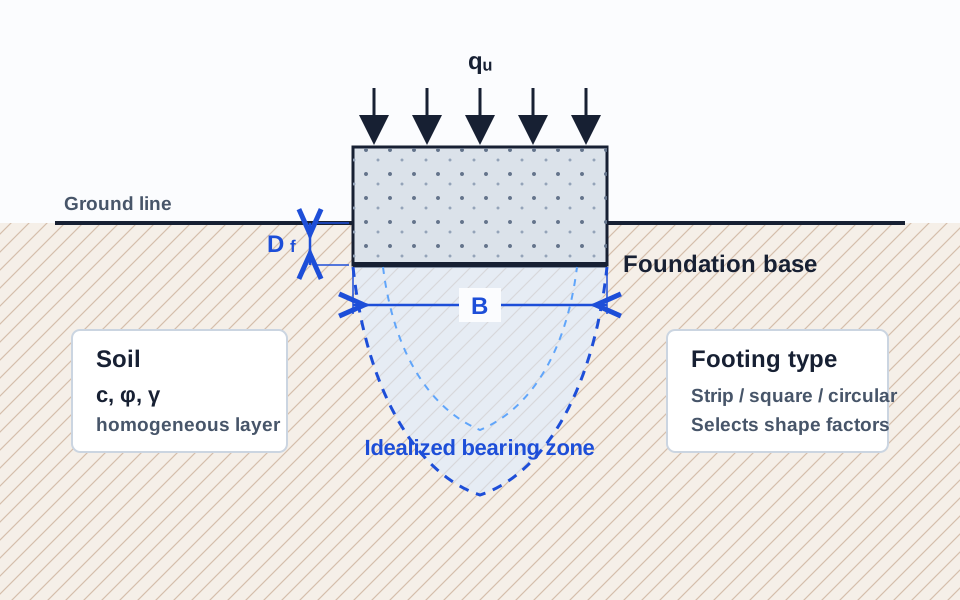
Calculation library
Foundation tools in design order
Start with project-specific soil parameters and compatible load combinations. The tools support preliminary calculations and independent checking; they do not select design parameters or replace a sealed design.
Step 1
Bearing Capacity Calculator
Screen shallow foundation bearing capacity using a Terzaghi-style calculation.
Open calculatorStep 2
Footing Size Calculator
Size square, rectangular, or continuous strip footings from service load and allowable soil bearing pressure.
Open calculatorStep 3
Footing Contact Pressure Calculator
Calculate biaxial corner pressures, eccentricities, kern status, and allowable-pressure utilization for a rigid rectangular footing.
Open calculatorStep 4
Elastic Settlement Calculator
Estimate immediate shallow-foundation settlement using net pressure, footing width, soil modulus, Poisson ratio, and an engineer-selected influence factor.
Open calculatorStep 5
Axial Pile Capacity Calculator
Combine project-specific average shaft and toe resistances to estimate ultimate and allowable compression capacity for one circular pile.
Open calculatorTechnical library
Foundation systems, selection, and limitations
Use these guides to choose an appropriate model before opening a calculator. They cover foundation applications, load transfer, serviceability, construction risks, and the boundaries of simplified methods.
11 min
Types of Foundations: Shallow and Deep Systems Explained
A practical guide to spread footings, strip footings, mats, driven piles, drilled shafts, micropiles, and other foundation systems.
Read guide10 min
How Engineers Select a Foundation Type
A step-by-step foundation selection framework based on loads, ground conditions, settlement, groundwater, constructability, and project risk.
Read guide12 min
Foundation Design Workflow for Structural Engineers
A coordinated structural-geotechnical workflow from reactions and soil recommendations through footing pressure, settlement, strength, and construction documents.
Read guide10 min
Spread Footings: Applications, Design Checks, and Limitations
Engineering guide to isolated spread footings, including bearing pressure, eccentricity, settlement, structural checks, and unsuitable conditions.
Read guide9 min
Strip, Combined, and Strap Footings
How continuous, combined, and strap footings distribute column and wall loads, with applications, pressure models, and design limitations.
Read guide10 min
Mat and Raft Foundations: Applications and Limitations
When mat foundations are used, how they interact with soil, and why bearing pressure alone is not enough for design.
Read guide11 min
Foundation Settlement: Total, Differential, and Angular Distortion
How immediate, consolidation, and secondary settlement affect foundations, and why differential movement often controls performance.
Read guide10 min
Eccentric Footing Loads, Kern Checks, and Partial Contact
How moments shift footing resultants, change corner pressure, and cause partial soil contact under uniaxial or biaxial loading.
Read guide11 min
Driven Piles vs. Drilled Shafts
Engineering comparison of driven piles and drilled shafts, including load transfer, applications, construction risks, testing, and limitations.
Read guide10 min
Micropiles and Helical Piles: Applications and Limitations
Practical comparison of micropiles and helical piles for underpinning, retrofit, uplift, restricted access, and new construction.
Read guide11 min
Common Foundation Failure Modes
Foundation failure modes including bearing failure, settlement, sliding, overturning, uplift, scour, expansive soil movement, and construction defects.
Read guide12 min
Foundation Construction Inspection and Quality Control
Practical inspection and acceptance guide for shallow foundations, driven piles, drilled shafts, micropiles, and augered piles.
Read guideWorked foundation examples
9 min
Axial Pile Capacity Example
Worked circular pile example combining average shaft resistance and toe resistance to calculate ultimate and allowable axial capacity.
9 min
Biaxial Footing Contact Pressure Example
Worked rectangular footing example calculating eccentricities, kern status, four corner pressures, and allowable-pressure utilization.
8 min
Elastic Foundation Settlement Example
Worked SI-unit example estimating immediate elastic settlement and evaluating the assumptions that control the result.
8 min
Spread Footing Sizing Example
Worked service-load example for sizing and rounding a rectangular spread footing using allowable soil pressure.
A foundation design is a system of checks
Bearing capacity alone is not a foundation design. Geometry, load path, soil response, groundwater, construction sequence, and structural detailing interact. Settlement or eccentric loading often controls even where an ultimate bearing calculation appears comfortable.
1
Establish the ground model
Define stratigraphy, groundwater, design parameters, variability, and construction constraints from a site-specific investigation.
2
Select a foundation concept
Compare shallow and deep alternatives using load level, settlement tolerance, bearing conditions, nearby construction, and constructability.
3
Check geotechnical resistance
Evaluate bearing, sliding, uplift, axial or lateral resistance, and applicable limit states with a compatible design format.
4
Check serviceability
Evaluate total and differential settlement, rotation, cyclic response, and movement sensitivity of the supported structure.
5
Complete structural design
Design footing, mat, pile, shaft, cap, reinforcement, connections, durability, and load transfer under the governing structural code.
Shallow foundation review
- Bearing resistance at the selected founding level
- Gross versus net service pressure and load basis
- Eccentricity, kern, uplift, sliding, and overturning
- Immediate, consolidation, and differential settlement
- Punching shear, one-way shear, flexure, and development
- Groundwater, frost, expansive soil, scour, and adjacent excavation effects
Deep foundation review
- Shaft and toe resistance by soil or rock layer
- Settlement and load-transfer behavior
- Group efficiency, block failure, and pile-cap interaction
- Downdrag, uplift, lateral loading, cyclic loading, and scour
- Pile or shaft structural capacity and constructability
- Static or dynamic load testing and installation acceptance
Core shallow-foundation relationships
Core deep-foundation relationship
The summation form is preferred for layered profiles. The calculator uses one entered average shaft resistance as a transparent first-pass implementation.
Load basis matters. Use service loads with allowable pressures and compatible factored loads with factored resistances. Confirm net versus gross pressure, groundwater basis, and governing design criteria before comparing results.