Foundations
Elastic Settlement Calculator
Estimate immediate shallow-foundation settlement using net pressure, footing width, soil modulus, Poisson ratio, and an engineer-selected influence factor.
Engineering schematic
Immediate elastic settlement model
Static symbolic figure. Enter project values in the calculator fields below.
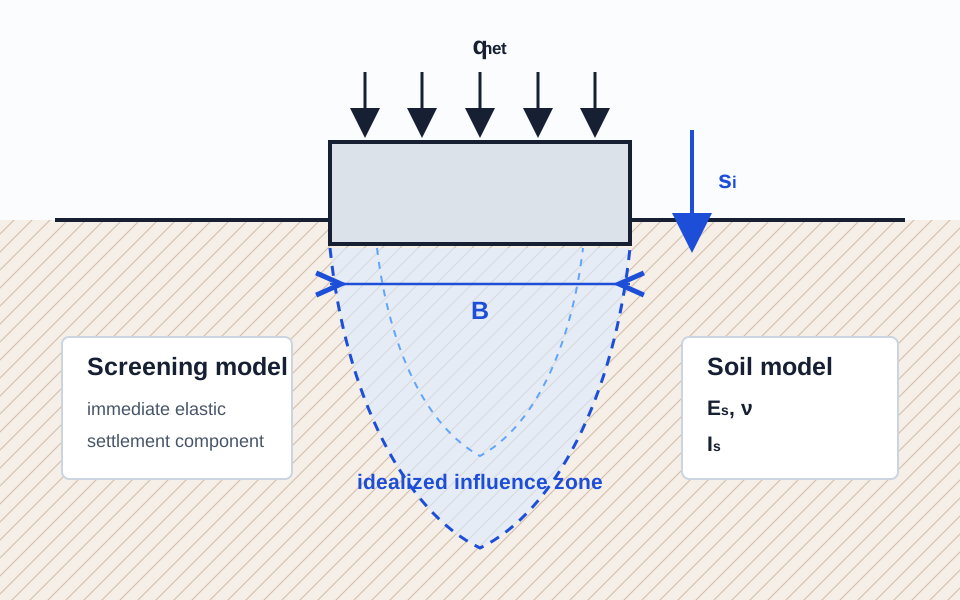
- qnet
- net service pressure applied at foundation level
- B
- footing width
- Es, ν
- soil elastic modulus and Poisson ratio
- Is, si
- combined influence factor and immediate settlement
Result
Estimated immediate settlement: 0.44 in
Pressure/modulus ratio
0.006
Elastic settlement
0.44 in
Influence factor
1.12
Step-by-step calculation
- Elastic settlement
- Substitution
- Estimated settlement
What this means
This is an immediate elastic settlement screening value. Compare total and differential movement against project-specific serviceability criteria using an appropriate subsurface model.
Important limitations
- This calculation does not include consolidation, secondary compression, layered-soil integration, rigidity corrections, stress history, or construction sequence.
Assumptions
- Homogeneous isotropic elastic soil idealization
- Flexible footing influence represented by the entered factor
- Net service pressure
- Modulus represents the relevant stress range and influence depth
Formula Used
Step-by-Step Example
For qnet = 3 ksf, B = 6 ft, Es = 500 ksf, nu = 0.30, and Is = 1.12, the simplified immediate settlement is about 0.44 in.
Engineering Notes
- Select modulus and influence factor for the soil profile, footing rigidity and shape, embedment, stress range, and drainage condition.
- Settlement influence extends below the footing; a single modulus can be misleading where compressible layers occur within the stress bulb.
- Calculate consolidation and secondary settlement separately where cohesive or organic soils govern time-dependent movement.
- Foundation serviceability normally depends on differential settlement, angular distortion, construction sequence, and structural tolerance as well as total settlement.
FAQ
Is this total foundation settlement?
No. It estimates an immediate elastic component only. Consolidation, secondary compression, collapse, heave, and construction effects may also matter.
Which soil modulus should I use?
Use a project-specific modulus representative of the relevant strain level, drainage condition, and depth of influence. Modulus selection is often the largest source of uncertainty.
What is the influence factor?
It combines corrections that may account for footing shape, rigidity, embedment, and the point where settlement is evaluated. Use a value from the selected method, not a generic default without review.