Geotechnical Engineering
Infinite Slope Factor of Safety Calculator
Calculate infinite-slope factor of safety from slope angle, soil thickness, unit weight, cohesion, friction angle, and pore-pressure ratio.
Engineering schematic
Infinite-slope stress convention
Static symbolic figure. Enter project values in the calculator fields below.
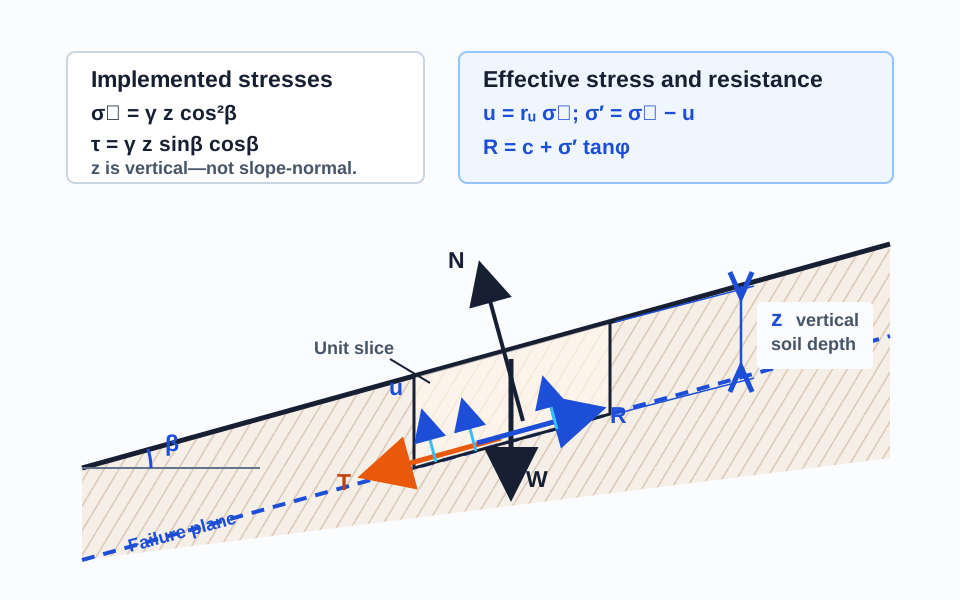
- β
- slope angle
- z
- vertical soil depth used by the implemented equation
- W, N, T
- slice weight, normal force, and downslope shear force
- u, rᵤ
- pore pressure and ratio defined by u = rᵤσₙ
- c, φ, γ
- cohesion, friction angle, and soil unit weight
Result
Factor of safety: 1.46
Normal stress
295.7
Driving stress
137.89
Pore pressure
59.14
Resisting stress
200.78
Factor of safety
1.46
Step-by-step calculation
- Normal stress
- Driving shear stress
- Pore-water pressure
- Factor of safety
What this means
The slope is marginal in a screening sense and deserves closer evaluation.
Assumptions
- Infinite slope geometry
- Planar shallow failure surface
- Consistent unit system
- No seismic loading
Formula Used
Step-by-Step Example
A 25 degree slope with 3 ft soil thickness, c=75 psf, phi=28 deg, and ru=0.2 has a screening FS near 1.46.
Engineering Notes
- Use the model only where a shallow planar failure surface approximately parallel to the ground is credible.
- Treat c and phi as parameters for the selected drainage and stress condition; do not mix total-stress cohesion with effective-stress friction casually.
- The calculator defines u from ru times the total normal overburden term. Check whether that representation is suitable for the seepage condition.
- Run wet-season and parameter sensitivity cases. A single dry factor of safety can conceal groundwater control.
- Final slope evaluation may require stratigraphy, noncircular or circular surfaces, seismic loading, external loads, and project-specific target factors of safety.
FAQ
When is the infinite slope model appropriate?
It is most useful for shallow translational screening where the potential failure surface is approximately parallel to a long, uniform ground surface.
How does groundwater affect the result?
Pore pressure reduces effective normal stress and therefore frictional resistance. Wet-season and seepage sensitivity checks are usually more informative than one dry calculation.
Is a factor of safety above 1.0 acceptable?
Not automatically. The target depends on consequence, uncertainty, loading, method, project criteria, and whether the credible failure mechanism was modeled.